Blog
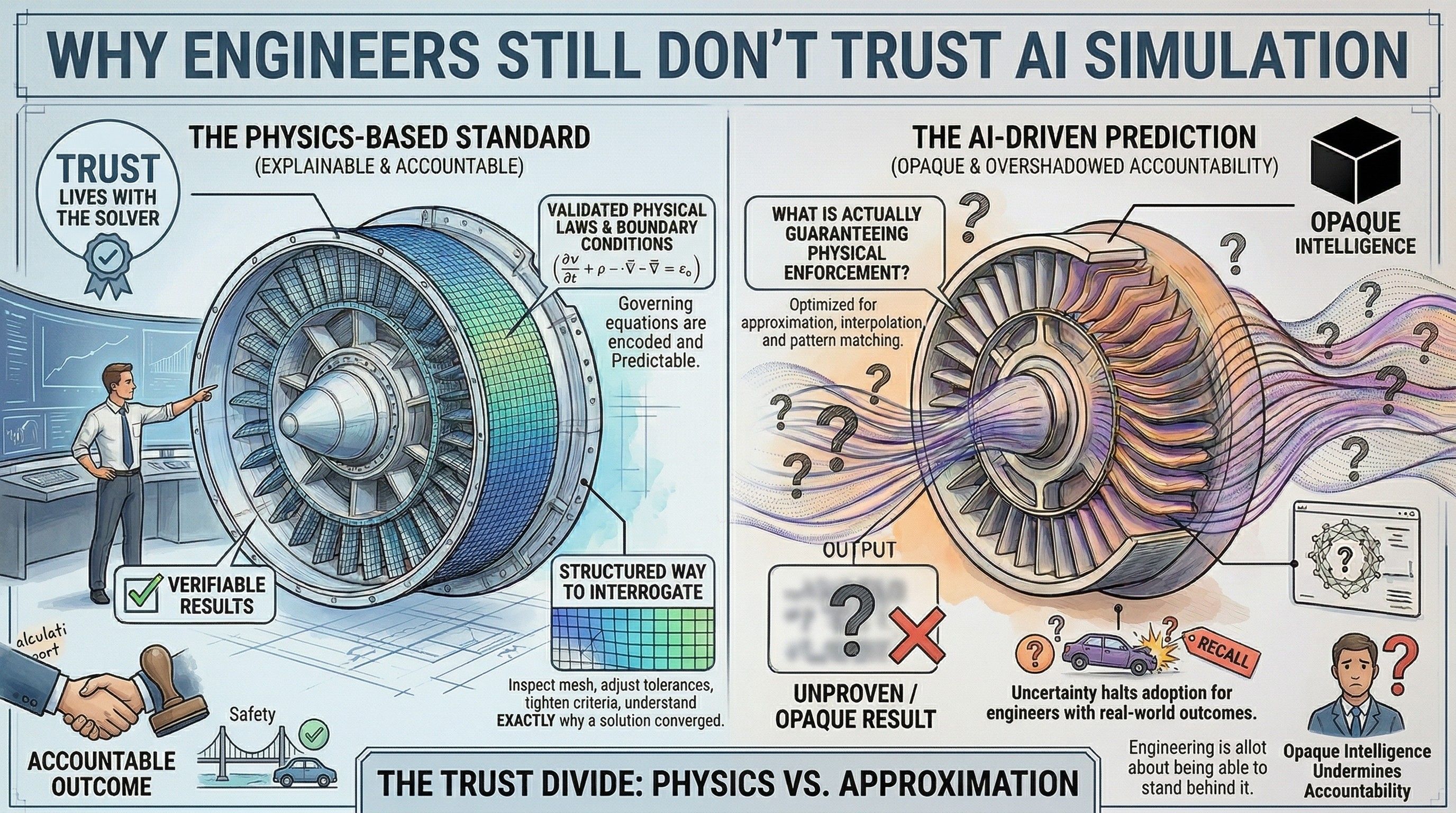
Engineers don’t distrust AI. They distrust bad decisions dressed up as design intelligence.
That distinction matters, because engineering skepticism isn’t ideological. It’s learned. It comes from being accountable for systems where failure isn’t theoretical, where mistakes show up as safety incidents, regulatory violations, recalls, or years of rework long after a demo has ended.
I’m an engineer myself, and after spending time inside real simulation teams, I’ve learned that resistance to AI isn’t about fear of new tools. It’s about whether those tools respect the foundations engineering is built on: physical laws, validated numerical methods, clear assumptions, and the ability to explain why a result is correct, not just that it exists.
The First Problem: Trust Lives With the Solver
In serious engineering environments, trust doesn’t come from speed or visual plausibility. It comes from physics.
That’s why physics solvers sit at the center of simulation workflows. They encode governing equations, numerical schemes, boundary conditions, tolerances, and convergence criteria that have been tested, validated, and signed off on for decades. Engineers rely on them because they behave predictably under scrutiny. When something looks wrong, there is a structured way to interrogate the result, inspect the mesh, adjust assumptions, tighten tolerances, and understand exactly why a solution converged or didn’t.
Many AI simulation tools implicitly ask engineers to move that trust somewhere else.
Instead of the solver enforcing correctness, AI-generated outputs often sit ahead of it or alongside it, optimized for approximation, interpolation, or pattern matching rather than strict physical enforcement. Even when results look impressive, they raise a critical question: what is actually guaranteeing that this output obeys the same physical laws as the real system?
For engineers responsible for real-world outcomes, that uncertainty alone is enough to halt adoption.
The Second Problem: Opaque Intelligence Undermines Accountability
Engineering isn’t just about producing an answer. It’s about being able to stand behind it.
Traditional simulation workflows allow engineers to reason about results in terms of inputs, assumptions, constraints, and solver behavior. Even when the mathematics are complex, there is a clear conceptual chain from setup to outcome. That chain is what enables review, iteration, and ultimately sign-off.
In automotive engineering, sign-off means certifying that crash structures, braking systems, or thermal limits meet safety standards before vehicles ever reach production.
In aerospace, it means approving aerodynamic loads or stability margins that aircraft will rely on for decades of flight.
In defense, it means validating systems where failure has national, legal, and human consequences.
Many AI-driven approaches weaken this chain. When a model produces results without a clear, inspectable relationship to governing physics, engineers lose the ability to reason about why a solution looks the way it does. That doesn’t just make debugging harder, it makes accountability unclear. If a problem emerges later during manufacturing, certification, or operation, it’s no longer obvious where responsibility lies.
In domains where safety, compliance, and financial risk are non-negotiable, that ambiguity is unacceptable.
The Third Problem: Engineers Have Seen AI Fail Quietly Before
This skepticism isn’t hypothetical. Engineers have lived through earlier waves of AI optimism.
They’ve seen models perform well within narrow training regimes and then degrade unpredictably at the edges. They’ve watched tools promise generality and deliver brittleness. Most importantly, they’ve encountered failures that weren’t immediately obvious—results that converged quickly, looked reasonable, and only later revealed violations of assumptions that actually mattered.
The issue isn’t that AI makes mistakes. Every tool does.
The issue is that some AI systems don’t reliably signal when they’re operating outside their depth.
In aerospace, that can mean confidently predicting flow behavior in regimes the model was never trained on.
In automotive systems, it can mean subtle errors in thermal or structural assumptions that only surface under rare but critical conditions.
In defense applications, it can mean outputs that appear valid but quietly break constraints that only become visible during integration or deployment.
For engineers trained to think in terms of failure modes, that silence is a serious red flag.
What Engineers Actually Want From AI
When you step back, the pattern is clear. Engineers aren’t asking AI to replace physics. They’re asking it to work with physics.
They want tools that help them explore more design space earlier, reduce wasted computation, and converge faster, without bypassing the mechanisms that enforce correctness. They want acceleration that degrades safely, not shortcuts that silently invalidate results.
In practice, that means AI behaving like a highly capable assistant: proposing better starting points, learning from past runs, and improving efficiency, while the solver remains the final authority.
Why Talos Takes a Different Approach
Talos was built around this exact insight.
Instead of positioning AI as a substitute for simulation, Talos embeds AI inside the solver’s existing workflow. The solver remains fully in control, enforcing physical laws and convergence criteria exactly as before. Talos helps the solver reach valid solutions faster by learning from prior simulations and proposing more informed initial conditions.
If those suggestions are good, convergence accelerates. If they’re not, the solver corrects them.
Nothing passes unless it satisfies the same standards engineers already trust.
Progress Engineers Can Stand Behind
Real progress in AI simulation means engineers remain accountable, physics remains authoritative, and AI operates as an amplifier, not a replacement, of proven methods.
That’s the problem Talos is designed to solve.
If you’re responsible for simulation accuracy, development timelines, or engineering risk, the right next step isn’t hype or abstraction. It’s a technical conversation.
Schedule a 30-minute consult with a Talos engineer to see how solver-verified AI acceleration fits into your existing workflow. (hyperlink to https://www.talosaps.com/contact)
FAQs
Frequently Asked Questions
What does Talos actually do?
Why does this matter?
What problem exists today?
What is a “solver”?
Does Talos replace the physics solver?
Can Talos give a wrong answer?
Why is this safer than other AI approaches?
Can results be audited or reviewed later?
How does Talos protect our top-secret or proprietary intellectual property?
What does onboarding and training look like for our team?
How much does Talos cost?
Is Talos hard to install or adopt?
Does Talos require cloud access or data sharing?
Why not just buy more computing power?
Still have a question?
Get in touch with us and let's discuss it.
