Blog
The startup ecosystem is buzzing with a seductive idea: With enough data and massive computing power, we can build a "Foundational Model" for the physical world. The vision is an AI that completely replaces traditional, slow engineering software predicting fluid dynamics, aerodynamics, or structural stress as instantly and easily as ChatGPT predicts the next word in a sentence.
It is an incredibly appealing pitch for investors. But based on the strict mathematics of engineering, it is practically impossible to achieve just by scaling up data.
Understanding why is the difference between backing a revolutionary engineering tool and pouring capital into a scientific dead end. Here is why pure AI models cannot replace traditional physics simulators, why buzzy alternatives like PINNs fall short, and where the real multi-billion-dollar opportunity lies.
1. The Precision Floor: Rulers vs. Laser Micrometers
If an AI language model hallucinates a slightly wrong word, the sentence usually still makes sense. But if an engineering simulation is off by a fraction of a percent, a bridge collapses, a jet engine fails, or a pressurised well blows out.
Standard engineering software requires extreme precision , specifically an accuracy margin down to the sixth decimal place (what engineers call a relative error of 1E6. To compute at this level, systems must use 64-bit precision (Float64), the digital equivalent of a laser micrometer.
However, the entire modern AI boom from chips to the math underlying Large Language Models is built on 16-bit precision (Float16) to process data as fast and cheaply as possible. Float16 is like a wooden ruler; it only mathematically holds about three or four decimal places of accuracy. Trying to achieve aerospace-grade precision on 16-bit AI hardware isn't a software bug it is a physical constraint of the system. The AI simply does not possess the decimal places to give engineers the answers they legally need to sign off on safety designs.
2. The Data Black Hole: Physics is Not the Internet
Even if we forced the AI to use 64-bit precision, we would hit a staggering data wall. We are used to the idea that LLMs get smarter simply because we can scrape more text from the internet.
But in AI, there is a mathematical trap called the "Curse of Dimensionality." Every time you add a new variable to a physics problem (3D geometry, temperature, fluid speed, pressure, time), the amount of training data you need to maintain high accuracy grows exponentially.
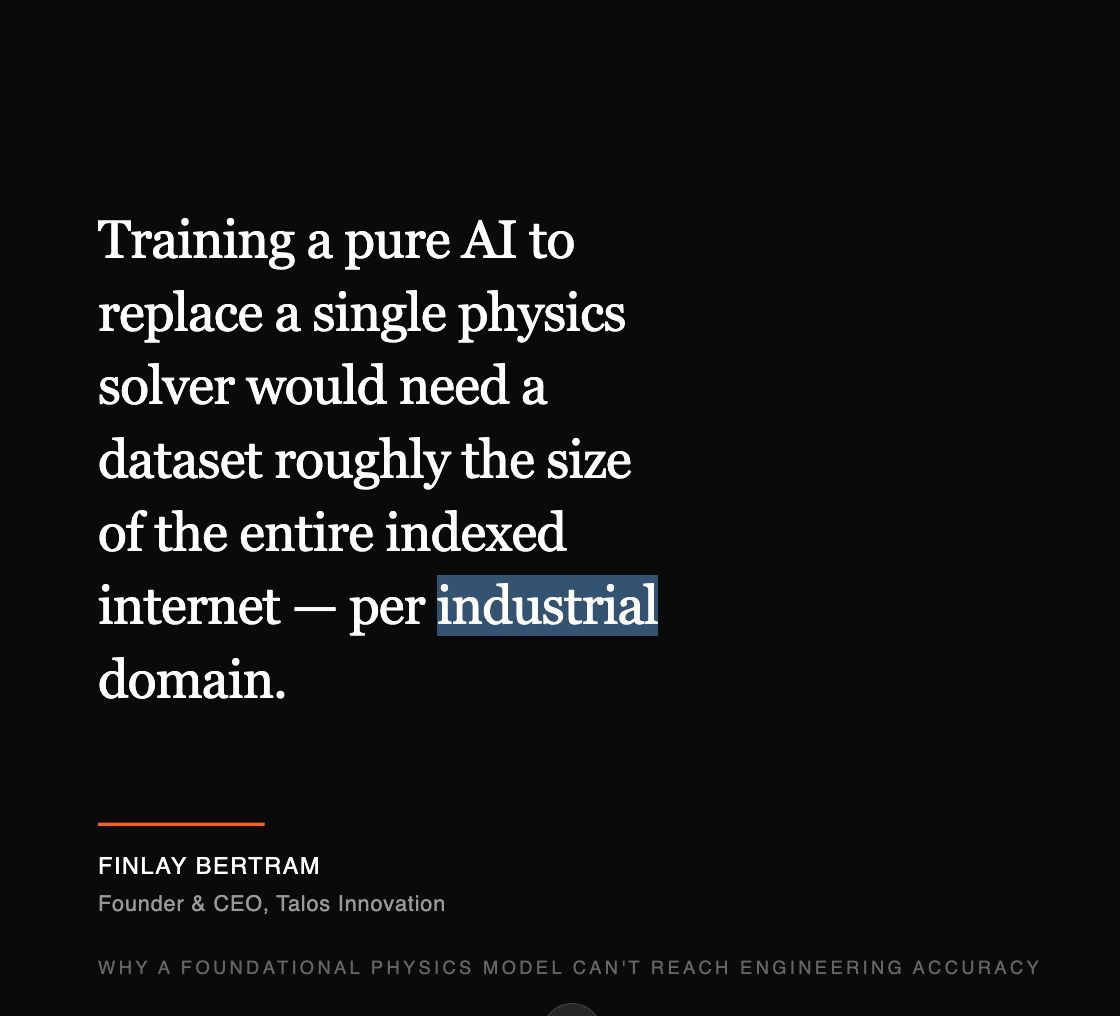
To train an AI model to reach 1E6 accuracy purely from data, you would need to run billions of traditional, high-fidelity simulations just to create the training dataset. For a single industrial domain (like simulating a commercial airplane wing), this dataset would be roughly between one exabyte to one zettabyte in size. That is equivalent to the entire indexed internet. No company on earth has the time, capital, computing power, or server space to generate and store that.
3. The Real World is "Spiky" (And AI Hates That)
Neural networks are fantastic at recognising smooth, gradual patterns. Language and images generally follow predictable trends.
But industrial physics is violently "spiky." Think of a supersonic shockwave hitting a jet wing, water instantly flashing into steam, or chaotic air turbulence. In math, these are called "discontinuities." Neural networks naturally struggle with these sudden cliff edges and tend to blur them out. To get an AI to accurately predict a shockwave without blurring it, you have to feed it microscopic data exactly at the point of the shock which requires running the exact traditional software you were trying to replace in the first place.
4. The False Comfort of PINNs (Physics-Informed Neural Networks)
When faced with these massive data problems, founders often pivot to pitching PINNs. The pitch: "We don't need infinite data, because we bake the actual laws of thermodynamics and physics directly into the AI's code!"
Instead of just showing the AI millions of examples, a PINN penalises the AI during training if its answers violate the mathematical laws of physics (like the conservation of mass). While PINNs are highly popular in academic papers, VCs and industry leaders are quickly realising they have fatal commercial flaws:
The Optimisation "Tug-of-War": Forcing an AI to balance matching the data and perfectly obeying complex physics equations creates a nightmare for the AI's learning process. The model often gets confused, gets stuck fighting itself, and fails to learn the complex details of the system entirely.
Physics as a "Suggestion": Traditional engineering software mathematically guarantees that mass and energy are conserved. PINNs treat physics equations as "soft constraints" (penalties). This means a PINN might output a simulation where 1% of the fluid simply vanishes into thin air. Engineers cannot legally sign off on designs that violate the laws of physics, even slightly.
The "Blurry Vision" Flaw: PINNs suffer from "spectral bias," meaning they notoriously fail to capture high-frequency, chaotic details like fluid turbulence which are the exact details critical to industrial design.
They Don't Generalise: The promise of a foundation model is instant answers for any new scenario. But PINNs are incredibly rigid. If you slightly change the shape of the airplane wing you are testing, you often have to retrain the PINN from scratch. It takes longer than just running traditional legacy software.
The Winning Bet: AI as an Accelerator, Not a Surrogate
If building a Surrogate (an AI that entirely replaces the traditional physics solver) is mathematically doomed, where is the massive venture ROI?
The commercially viable answer is using AI as an Accelerator. Talos Innovation's patent granted method does exactly this.
Instead of asking the AI to be 99.9999% accurate on its own, we ask it to make a highly educated rough draft (say, 90% to 99% accurate). We then hand that initial guess to the traditional, mathematically proven physics software to finish the last mile of the calculation.
Why this is the Holy Grail for industrial engineering:
Data needs drop by a factor of a million: The AI only needs to be "roughly right," making training completely feasible and cheap today.
Accuracy is mathematically guaranteed: The final answer comes from the traditional solver. Engineers get the exact 1E6 precision they need for safety certifications.
Massive speedups: Because the traditional software is handed a puzzle that is already 90% solved, it finishes days or weeks of computing in mere minutes.
Built-in fail-safes: If the AI hallucinates or gets confused by a weird edge-case, it doesn't silently return a dangerous answer. The traditional solver simply ignores the bad guess and takes a little longer to do the math itself. Accuracy is never at risk; only speed.
The Bottom Line for Investors
The statistical scaling laws that gave us ChatGPT do not transfer cleanly to the physical world. Text is forgiving; physics is unforgiving.
When evaluating AI-for-engineering startups, investors should stop asking, "Can your AI replace traditional solvers like Ansys or Siemens?" The math says it cannot.
The winning question is: "What is your division of labor between AI’s blazing speed and traditional software’s guaranteed safety?" Startups that ask AI to do the entire job will burn endless capital chasing a mirage. Startups that position AI to dynamically accelerate proven solvers are the ones that will actually revolutionize multi-billion-dollar engineering markets.
FAQs
Frequently Asked Questions
What does Talos actually do?
Why does this matter?
What problem exists today?
What is a “solver”?
Does Talos replace the physics solver?
Can Talos give a wrong answer?
Why is this safer than other AI approaches?
Can results be audited or reviewed later?
How does Talos protect our top-secret or proprietary intellectual property?
What does onboarding and training look like for our team?
How much does Talos cost?
Is Talos hard to install or adopt?
Does Talos require cloud access or data sharing?
Why not just buy more computing power?

Still have a question?
Get in touch with us and let's discuss it.
