Blog
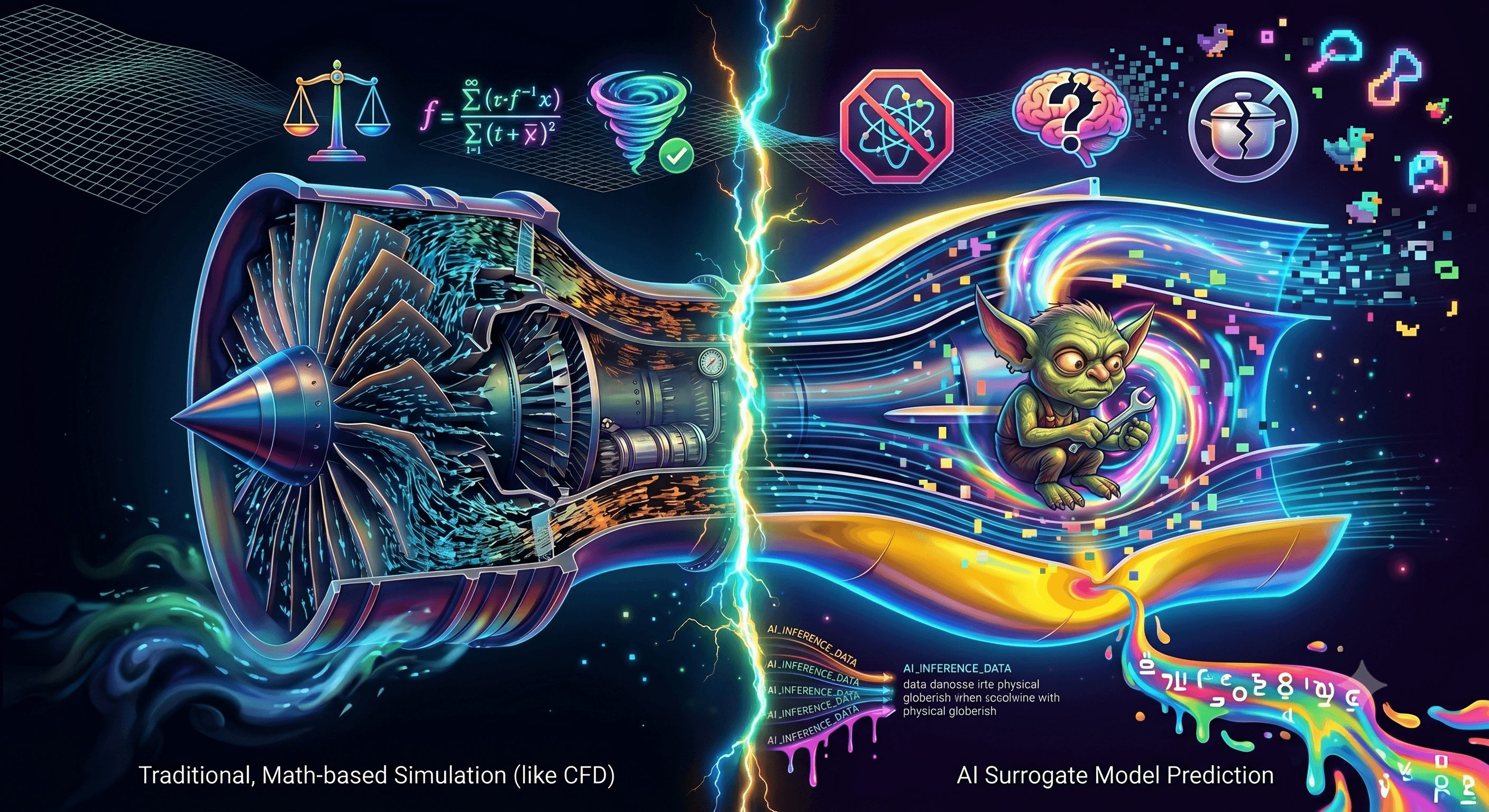
When Your AI Speaks for the Laws of Physics, Who Owns What It Says?
Two days ago, news broke of a landmark ruling from the Regional Court of Munich: Google is legally liable for false statements made in its AI Overviews, because the AI synthesises sources into "independent, new, and substantive statements." In the eyes of the law, Google isn't just linking to information anymore. It is the author of those claims.
Google tried to argue that users could just "check the linked sources themselves." The court rejected this outright, the mere possibility of verifying a statement does not exempt the publisher from liability for making it. The court added a detail that should chill every AI vendor: only Google is positioned to check its AI's statements against the underlying sources. The burden of verification sits with whoever built the machine.
Here is why this exact legal precedent should be a massive wake-up call for the booming industry of enterprise AI companies building deep learning tools for engineering and physics and why we built Talos the way we did.
The Rise of the "Physics Oracle"
There is a massive push to use AI to accelerate complex physical simulations. Traditionally, industries like aerospace, Formula 1, automotive, and energy rely on the deterministic math underlying Computational Fluid Dynamics (CFD) and Finite Element Analysis (FEA). These are highly accurate but computationally brutal.
As VC capital pours into AI engineering startups, a quiet reality that engineers have always known about is heading for a nasty collision with the bets being made in this space. Most of these companies build "surrogate models", geometric deep learning tools that learn the physics from past data and predict the outcome in seconds rather than days.
But there is a catch: these models don't actually calculate the physics. They guess it. And just like ChatGPT, they hallucinate.
Hallucinating Physical Reality
When a language model hallucinates, you get a fake legal citation or a weird recipe. When a physics AI hallucinates, it violates the laws of thermodynamics.
A surrogate might generate a beautiful 3D model of airflow over a new aircraft wing while silently failing to conserve mass, or hallucinate an impossible thermal tolerance on a turbine blade. It might smooth over a critical vortex that a traditional, math-based CFD solver would have caught.
These are not harmless text errors. They are structural and aerodynamic hallucinations that, if acted upon, fail in the real world.
The "Run Your Own Simulation" Defence Fails
AI physics vendors lean on the same defence Google just lost with. They frame their products as "accelerators" or "copilots," with a disclaimer that says, implicitly: "You should still validate these results with traditional simulation or physical testing."
The Munich court's logic shatters this shield. When a surrogate outputs a confident, synthesised 3D stress map or an aerodynamic efficiency score, it is making an "independent, new, and substantive statement" about physical reality. The network generated that number. No governing equation was solved to produce it. The vendor is the author.
And just as the court noted that users rarely click source links to verify AI summaries, engineering teams under deadline pressure will inevitably stop running the slow, expensive CFD validation if the AI tells them the design is fine. That is the entire point of buying the software. A disclaimer that contradicts your own value proposition is not a legal strategy.
Liability Is an Architecture Problem, Not a Disclaimer Problem
This is where the industry splits in two, and the Munich ruling makes the split legible.
The question the court asked is simple: who authored the statement? Apply that question to physics AI and you get two very different answers depending on what's under the hood.
Surrogates replace the solver. The neural network is the author of every pressure field, every stress contour, every safety margin. There is no deterministic calculation behind the output — only an interpolation across training data, dressed in the visual language of simulation. When it hallucinates, there is no second author to point to. The vendor owns the statement, and after Munich, plausibly the liability too.
Talos accelerates the solver. We took the opposite architectural bet. Our neural networks never produce the answer. They produce proposals that put the deterministic solver closer to the solution before it begins its work. The solver then does what it has always done: iterate, enforce the governing equations, and converge to within residual tolerance. Every number that ships was computed by the same verified physics engine the industry has trusted for decades. The network just made it arrive sooner.
The distinction we use internally: surrogates teach AI to be a physicist. We teach AI to be a lab assistant. The assistant can fetch, prepare, and sugges, but the physicist signs the result.
Fail-Closed by Construction
A proposal-based architecture only matters if bad proposals can't slip through. So Talos guards against them.
Every neural suggestion passes through DefectGate, our fail-closed residual check: if the network's proposal does not demonstrably move the solver toward convergence, it is discarded and the solver proceeds classically. The worst case with Talos is the answer you would have gotten anyway, at the speed you would have gotten it. There is no failure mode in which a hallucination becomes a deliverable. We have formally verified this gating logic in theorems, zero gaps because "trust me" is exactly the defence the Munich court just rejected.
This is also why the regulatory question resolves so differently for the two architectures. Industries that simulate reality for a living already operate under verification-and-validation regimes, ASME V&V, EASA's AI roadmap, functional safety standards across automotive and energy. Those compliance artefacts attach to the solver. Keep the solver as the authority and the existing V&V chain remains intact; you have accelerated a qualified tool, not replaced it with an unqualified one. Replace the solver with a network and you start the qualification mountain from base camp and with the Munich precedent now suggesting you'll climb it under direct liability.
And no, physics compliance does not mean giving the speed back. In production Talos has significantly cut wall-clock times with the solver verifying every step. Speed and accountability are not in tension, unless your architecture made them so.
The Bottom Line for Physics AI
If you build and sell AI that simulates reality for enterprise engineering, you own the physics you output.
You cannot retreat behind the defence that your software is "just a predictive tool" or that "the engineer should have double-checked the math." Munich just closed that door.
If your model hallucinates a false safety margin on a load-bearing structure, the liability for that "independent, substantive statement" rests on your company.
The only durable defense is architectural: make sure the author of every number is a deterministic solver enforcing the governing equations — and make the AI provably unable to overrule it.
As predictive algorithms move into high-stakes engineering, the standard for accountability cannot drop. If your product claims to speak for the laws of physics, the question is no longer whether you'll be held liable when it breaks them. It's whether you built something that can't.
FAQs
Frequently Asked Questions
What does Talos actually do?
Why does this matter?
What problem exists today?
What is a “solver”?
Does Talos replace the physics solver?
Can Talos give a wrong answer?
Why is this safer than other AI approaches?
Can results be audited or reviewed later?
How does Talos protect our top-secret or proprietary intellectual property?
What does onboarding and training look like for our team?
How much does Talos cost?
Is Talos hard to install or adopt?
Does Talos require cloud access or data sharing?
Why not just buy more computing power?
Still have a question?
Get in touch with us and let's discuss it.
