Blog
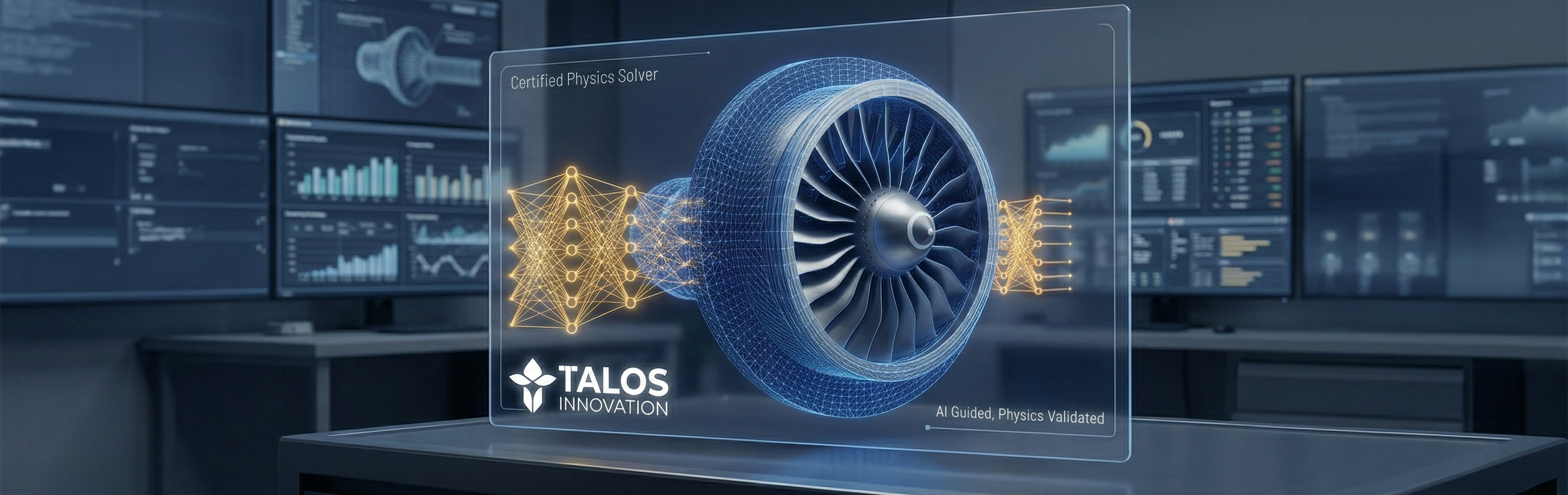
Engineering Simulation Built on Physics, Not Promises
There’s a common assumption that AI’s role in engineering is to make simulations faster. I think that framing misses the real problem.
In real engineering environments, where aircraft fly, vehicles carry families, factories operate under regulation, and failures have consequences, speed without trust isn’t progress. It’s risk.
Engineering has never been a domain where “pretty close” is acceptable. When a simulation is wrong, the cost isn’t a missed benchmark. It’s lost time, lost money, delayed programs, failed certification, damaged careers or in the worst case lives on the line. That’s why so many engineers remain skeptical of AI-driven simulation tools. And they’re right to be.
The industry has seen a pattern repeat itself: AI models that look impressive in demos, but quietly fail when conditions change, edge cases appear, or assumptions break. Those failures don’t announce themselves. They just produce answers that look reasonable, until an experienced engineer knows where to look and realizes something doesn’t add up, or reality proves otherwise.
That’s not a failure of AI capability. It’s a failure of verification and trust.
Don’t Replace What Already Works
Talos is built on a simple principle: don’t replace the systems engineers already trust. Strengthen them.
Physics already works. Certified solvers already work. They are the foundation engineers rely on to validate designs, meet regulations, and sign off on real-world systems. Our goal isn’t to rewrite physics or bypass solvers. It’s to remove friction from the process of discovering better designs without weakening verification.
Today’s engineering teams depend on physics solvers to enforce the laws of nature inside their simulation workflows. These solvers are accurate and reliable, but they’re also computationally expensive. As a result, engineers often can’t afford to explore the full design space. Instead, they guess what might work, then use simulation to validate those guesses after the fact.
That approach limits innovation, not because engineers lack ideas, but because exploration is constrained by cost, time, and risk.
How Talos Works (and Why It’s Safe)
Talos uses AI inside existing solver workflows—not instead of them.
AI proposes smarter starting points and directions to explore. The certified physics solver still runs every simulation.
The solver still enforces physical laws. The solver still determines convergence. The solver still produces the artifacts engineers rely on to review, audit, and sign off results.
If an AI suggestion is good, the solver converges faster. If an AI suggestion is wrong, the solver catches it automatically and slows down. That failure mode matters.
With Talos, the worst case is not an incorrect result that looks valid. The worst case is simply less acceleration on that run.
That single design choice, keeping the solver fully in control, is what makes Talos usable in serious, regulated engineering environments. Engineers never lose traceability, auditability, or accountability, because nothing replaces the solver they already trust.
Talos uses AI inside the solver workflow, not instead of it.
Learning Without Breaking Trust
Talos doesn’t just accelerate individual simulations. It learns from how the solver responds.
Every correction the physics makes becomes feedback. Over time, the system stops proposing ideas that consistently fail and begins surfacing directions that repeatedly hold up under physical law. Importantly, this learning never overrides verification. It happens within it.
The result isn’t blind automation. It’s guided exploration.
Engineers gain access to more viable design options earlier, without sacrificing the ability to defend every result. Exploration becomes broader, safer, and more creative, while remaining grounded in physics.
Why I Built Talos
Before founding Talos, I spent years working inside complex energy and industrial environments where simulation drives high-stakes decisions. I saw how much progress gets left on the table because meaningful exploration is too slow or too expensive. I also saw why shortcuts that can’t be explained, audited, or defended simply don’t survive in regulated reality.
Engineers don’t resist AI because they’re conservative. They resist AI because they’re responsible.
The future I care about is not replacing engineers’ judgment, it’s giving them better tools to apply it.
Moving from “simulate what you can afford” to “discover what’s truly possible”, without losing the ability to stand behind the results.
That’s what Talos is.
Not AI that replaces physics, but a trust layer that lets engineers explore bigger design spaces without giving up verification, safety, or credibility.
FAQs
Frequently Asked Questions
What does Talos actually do?
Why does this matter?
What problem exists today?
What is a “solver”?
Does Talos replace the physics solver?
Can Talos give a wrong answer?
Why is this safer than other AI approaches?
Can results be audited or reviewed later?
How does Talos protect our top-secret or proprietary intellectual property?
What does onboarding and training look like for our team?
How much does Talos cost?
Is Talos hard to install or adopt?
Does Talos require cloud access or data sharing?
Why not just buy more computing power?
Still have a question?
Get in touch with us and let's discuss it.
